Article · 10 min read
The Half-Day Wellness Reset in Colorado Springs
A half-day is enough time for a meaningful reset in Colorado Springs if you stop treating it like a truncated full day. This guide builds a four-to-five-hour sequence using local trails, food and simple recovery — specific, free and unhurried.
By Nora Whitfield, Wellness Editor · Published April 5, 2026 · Updated August 1, 2026
Key takeaway
A half-day wellness reset is not a compressed full-day retreat — it is a different kind of thing, with its own logic and its own places to do it in Colorado Springs.
A half-day reset is the wellness format that doesn't get its own category. It's too long for a quick break and too short for anything that requires packing or planning. Most people spend those four or five hours running errands, which is not a criticism — it's just not a reset. This guide is about using that window for something that actually leaves you feeling different at the end of it.
Colorado Springs is well set up for this format. The city has trail access close enough to reach without a significant drive, good food options that fit within a longer morning without feeling rushed, and enough canyon and open-space variety to satisfy a half-day with one destination and a slow pace. None of what follows requires a reservation, a membership or a prior relationship with the outdoors.
What a reset actually needs to do
A reset isn't about intensity or accomplishment. It's about creating a gap in the continuous low-grade attention load of a normal week: the phone, the decisions, the ambient monitoring of work and home and obligations. The gap is the point. Outdoor time, physical movement and unhurried food each contribute to it, but the common factor is that they don't require the same kind of attention.
This means the worst thing to do with a half-day reset is to fill it. Three destinations, two errands, a detour and a podcast playing the whole time is not a reset — it is a different kind of load. The guidance throughout this guide is toward one destination, minimal decisions once you arrive, and silence or near-silence as the default.
Choosing a location
The location for a half-day reset should satisfy a few criteria: accessible within twenty minutes from most parts of the city, enough space to spend two to three hours without feeling like you've circled back too many times, some variation in terrain or view to reward walking slowly, and at least one good place to sit and do nothing.
Half-day reset locations by character
| Location | Character | Best for |
|---|---|---|
| Red Rock Canyon Open Space | Dramatic rock formations, good trail network, some shade | Those who want visual variety and room to explore slowly |
| North Cheyenne Cañon | Creek, steep canyon walls, tree cover | Those who want to walk alongside water in shade |
| Garden of the Gods | Famous formations, paved and unpaved options, very accessible | Those who want scale and views without committing to a long trail |
| Palmer Park | Mesa views, eastern city feel, quieter on weekdays | Those who want open space closer to the east side |
| Ute Valley Park | Rolling terrain, interconnected trails, close to the north side | Those who want a longer walk without significant climbing |
A sample half-day sequence
This is one version. It is not a prescription — it is a template you can scale, swap and adjust. The logic is: slow movement first, stillness second, food third.
- Hours one and two: Walk at a pace where you're not breathing hard. No headphones, no destination goal. Turn around whenever, not on a schedule.
- Hour three: Find a place to sit — a rock, a bench, the edge of a clearing — and stay there for at least twenty minutes. No scrolling. Watch what's in front of you.
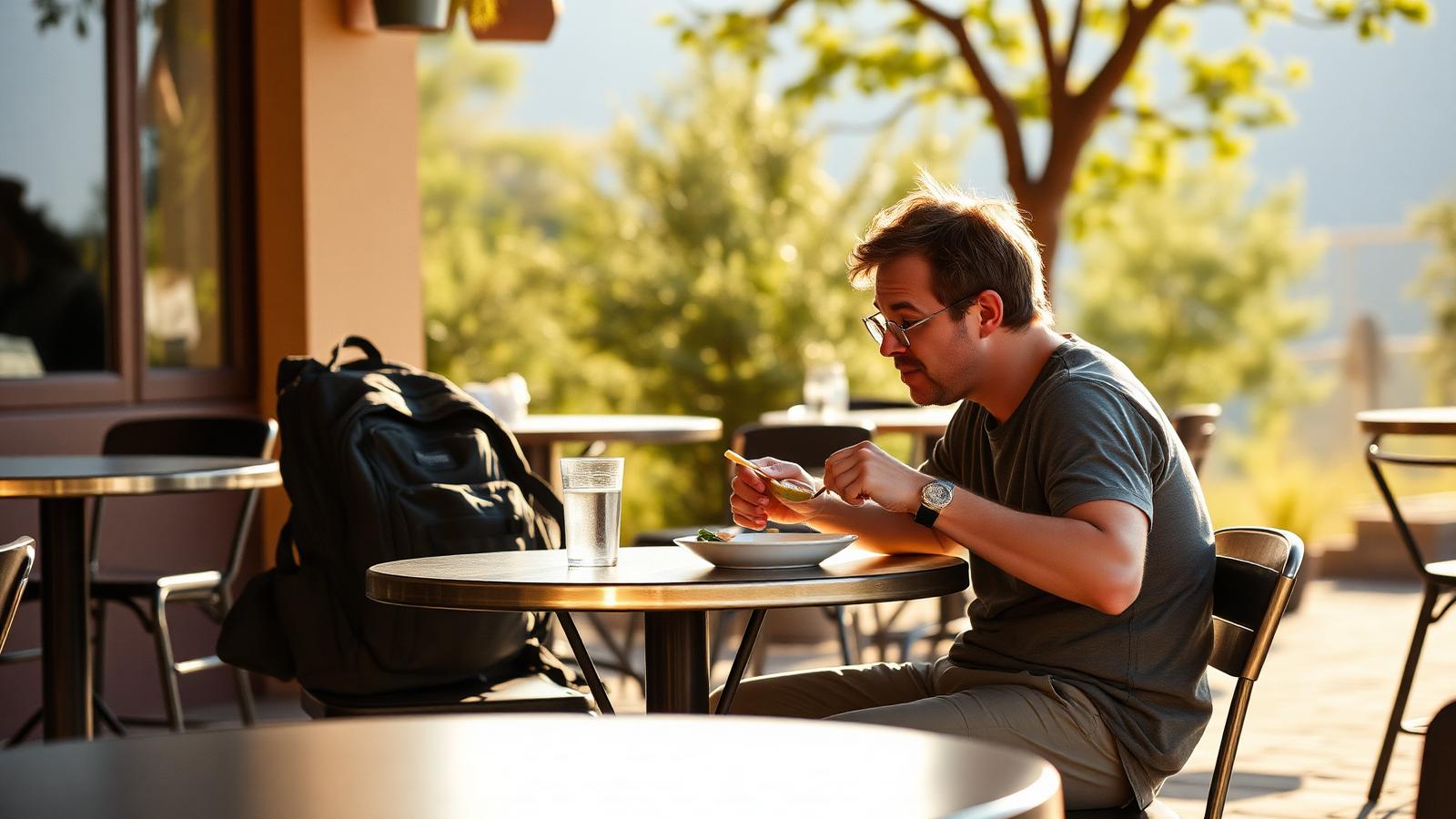
- Hour four: A meal, alone or with one other person, at a pace that lets you actually taste it. Ideally somewhere with a view out rather than in.
- Optional final half-hour: A ten-minute breathing session in the car before driving back. Longer exhale than inhale, four or five minutes, then quiet.
Managing altitude and sun
At 6,000 feet, a half-day outdoors is more physically demanding than the same time would be at sea level — specifically in terms of UV exposure and hydration. Neither requires elaborate preparation, but both require conscious attention. Sun protection is not optional, including in shoulder seasons when the air temperature suggests otherwise. A full bottle of water before you leave, and another in the bag, is the entire hydration plan.
If the reset falls in summer, adjust the sequence around the morning-only outdoor window. Begin no later than eight, aim to be off exposed ground or in shade by noon, and schedule the slow meal for the early afternoon when the thunderstorm risk is highest. That timing also happens to make the meal a better experience — less rushed, less competition for seats.
The recovery component
A half-day reset does not require a formal recovery session, but a brief one — fifteen minutes — substantially extends the aftereffect. The most reliable option is a slow breathing practice: sit somewhere comfortable, breathe in for four counts, out for six or eight. That asymmetry activates the parasympathetic response without requiring a posture, a belief system or a certification.
If a sauna is accessible to you — at a gym, a wellness facility, or through a friend with access — a twenty-minute session after the walk and before the meal is a strong addition. It is not necessary, and it is not right for everyone, but for those who tolerate heat well, the combination of walk plus sauna plus slow meal is one of the most effective half-day sequences available here.
Solo versus shared
A half-day reset done solo is a different experience from one done with another person. Neither is better, but they serve different needs. Solo resets are about quiet and self-directed attention. Shared resets work best with one other person whose default speed is slow and whose conversation style allows silence. Groups of three or more turn a reset into a social event, which is fine but is a different thing.
If you are doing this with someone else, agree in advance that headphones are out, phones stay in pockets during the walk, and there is no agenda beyond the sequence. The conversation, if it comes, will be better for having not been the point.
What to do afterward
The hours after a half-day reset are worth protecting. Don't schedule a demanding work block immediately after returning. Avoid social media for an hour. If you're back home, sit somewhere quiet for twenty minutes before switching back to the normal rhythm of the day. The reset has a half-life, and what you do in the first hour back determines how much of it you keep.
Frequently asked questions
- Do I need to hike during a half-day reset, or can I just sit somewhere?
- You can absolutely just sit. Forty-five minutes of walking and ninety minutes of sitting at a canyon overlook is a legitimate and effective reset. The movement is useful but it is not the point — the gap from the normal attention load is the point, and sitting in an interesting outdoor place achieves it.
- Which location is best if I'm not very fit or haven't been outside much recently?
- Garden of the Gods has paved paths and benches throughout, is largely flat near the visitor center, and offers a strong visual experience without requiring any real hiking. Monument Valley Park is another good option — flat, paved, accessible from multiple entry points and genuinely pleasant to walk slowly.
- What should I eat for the meal portion of the reset?
- Whatever you enjoy and can eat slowly without feeling rushed. A takeaway meal eaten at a picnic table with a view works as well as a restaurant. The criteria are: not fast food eaten in the car, not at a screen, and at a pace where you actually finish feeling satisfied rather than having noticed what you ate in retrospect.
- Can a half-day reset work if I only have two hours?
- Yes, but simplify the sequence. One location, one walk of forty-five minutes, twenty minutes sitting, and a meal to end. Two hours is enough for a genuine gap if you resist the urge to use the compressed time more efficiently.
- What if the weather is bad?
- Swap the outdoor component for a library visit or a slow indoor mobility session, keep the meal, and add the breathing practice. A bad-weather reset is less satisfying but still meaningful if the phone stays away and the pace stays slow.
Related places and practices
-
Westside
Red Rock Canyon Open Space
Quarry-scarred red rock, wide main trails and a lot of optional side loops — the middle ground between a park walk and a real hike.
-
Broadmoor & south
North Cheyenne Cañon
A steep, wooded canyon on the southwest side with everything from a short walk beside the creek to serious climbing on the connecting trails.
-
Westside
Garden of the Gods central garden walk
A mostly paved loop through the red sandstone formations on the west side — the easiest way in Colorado Springs to feel like you left the city without driving out of it.
-
East side
Palmer Park mesa trails
A large mid-city park with a web of dirt trails on the mesa — short loops for a lunch break, longer links if you want an hour of steady climbing.
-
Citywide
A sauna or steam session
Heat, then quiet. A simple recovery ritual that suits Colorado's dry cold months particularly well.
-
Citywide
Ten minutes of slow breathing
No app, no subscription, no belief system required. Sit, lengthen the exhale, notice when you drift, come back.
-
Citywide
A quiet hour at a public library
Free, indoor, weatherproof and genuinely quiet — the most underrated wellness infrastructure in any city, including this one.
Continue reading